

Bill Drill
Six shots on one target, usually at seven yards. The Bill Drill records the first shot, the intervals that follow and where all six rounds land.
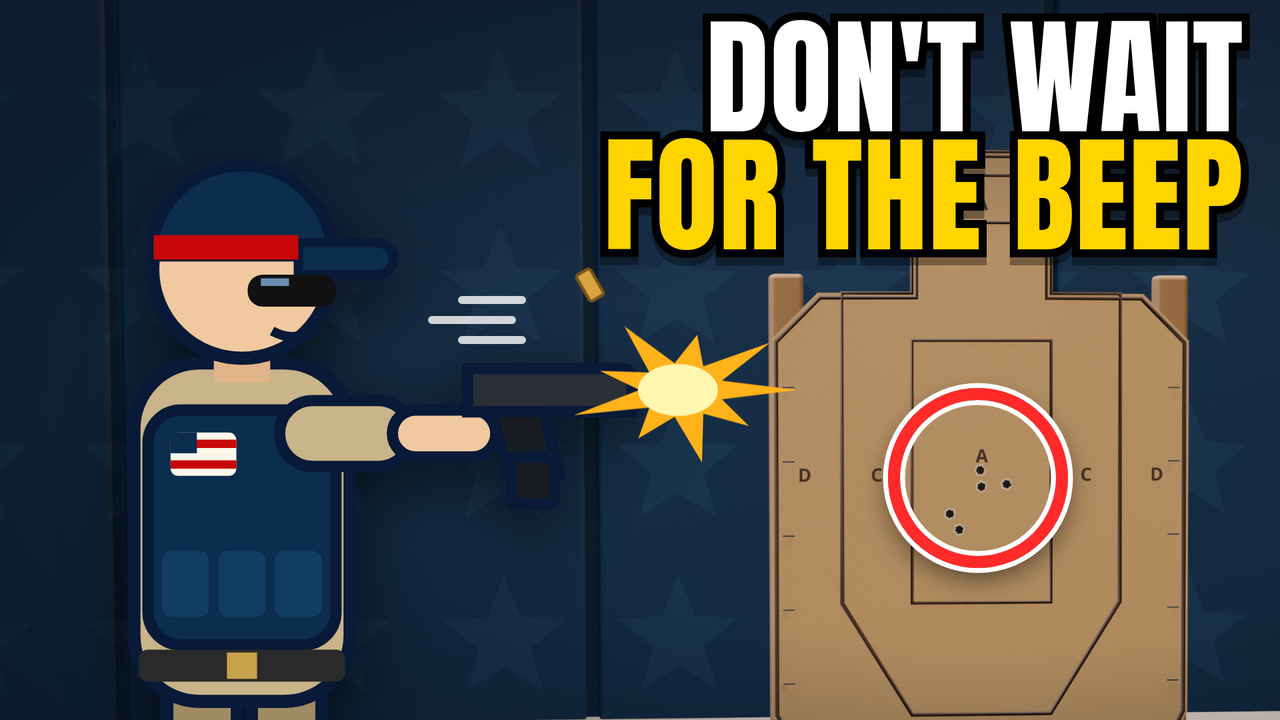
The video could not load here. Watch it on YouTube. The complete transcript is below.
Read the transcript ↓Watch on YouTube
Full video transcript 0:59
- 0:00
Today we're taking a look at the Bill Drill.
- 0:02
Six shots, one target, seven yards.
- 0:09
You can also run it at three or five yards. Here it is at three yards.
- 0:15
Up close, the target fills more of your view. It shows how good your natural point of aim is: point at something that close, and you're pretty accurate without even trying.
- 0:23
On the timer, your first shot is your draw time, and the gaps after it are your splits.
- 0:28
My favorite tip, which I learned from a friend: the beep on most shot timers lasts about half a second, and the clock starts when the beep starts. Don't wait for it to finish. Thanks, Matt.
- 0:37
It's named after Bill Wilson. The story goes that Rob Leatham named it after watching Wilson shoot it in practice.
- 0:42
I like this one because it's so simple. If you're getting all A-zone hits, push yourself to speed up and see where the wheels fall off.
- 0:48
If you've got a trusted gun store, type its name into USA Arms. If it isn't there, tell us and we'll look into it.
- Illustrated distance
- 7 yards
- Rounds
- 6
- Target
- One USPSA cardboard target
- Creator credit
- Bill Wilson
Distance and round count
The familiar Bill Drill is a six-shot string at seven yards. Our video illustrates six Alpha-zone hits; its narrated shot count is not a measured live-fire time. [1]
Ben Stoeger describes 3-, 5- and 7-yard versions. Karl Rehn also includes a 15-yard version in KR Training’s performance comparisons. The video’s second layout shows three yards. [1] [2]
What it measures
With no target changes or reload in the string, the timing record consists of the start-to-first-shot time and five intervals between shots. Stoeger uses different distances to change the accuracy demand. [1]
The six holes show whether that pace kept the hits in the intended area. The target and the shot times together describe the run. [1] [3]
Published time goals and scoring
KR Training’s compilation lists Bill Wilson’s three-second goal, a two-second competition benchmark associated with Brian Enos, and KR’s five-second reference. These come from different authors and equipment assumptions. [4]
Some versions require all hits in the intended zone. Others add time penalties for poorer hits. A clean raw time and a time with penalties are different scores. [2] [4]
Why it is called the Bill Drill
Wilson Combat and Rob Leatham credit Bill Wilson with the original exercise. Target Barn’s history reports that Leatham named it after Wilson. [5] [6] [3]
Bill Drill 2
Bill Drill 2 has five strings of one, two, three, four and five shots. That is fifteen rounds and five starts, rather than the original drill’s six rounds from one start. [4]
| Exercise | Structure | Total rounds |
|---|---|---|
| Bill Drill | One six-shot string | 6 |
| Bill Drill 2 | Five strings: 1 / 2 / 3 / 4 / 5 | 15 |
Sources and further reading
- Ben Stoeger — Bill Drillbenstoeger.com
- Karl Rehn — Relative Performance Measurementblog.krtraining.com
- Target Barn — The Bill Drilltargetbarn.com
- KR Training — Drills, Qualifications, Standards and Testsblog.krtraining.com
- Wilson Combat — Bill Drill historyyoutube.com
- Rob Leatham — Bill Wilson’s original drillyoutube.com
Sources reviewed September 29, 2026. Next review by March 29, 2027. Send a correction with a supporting source.