

Pistol Group Shooting
An untimed pistol group shows how widely shots spread and where they land. Our printable target runs five-shot groups starting at three to five yards, then ten and twenty-five.
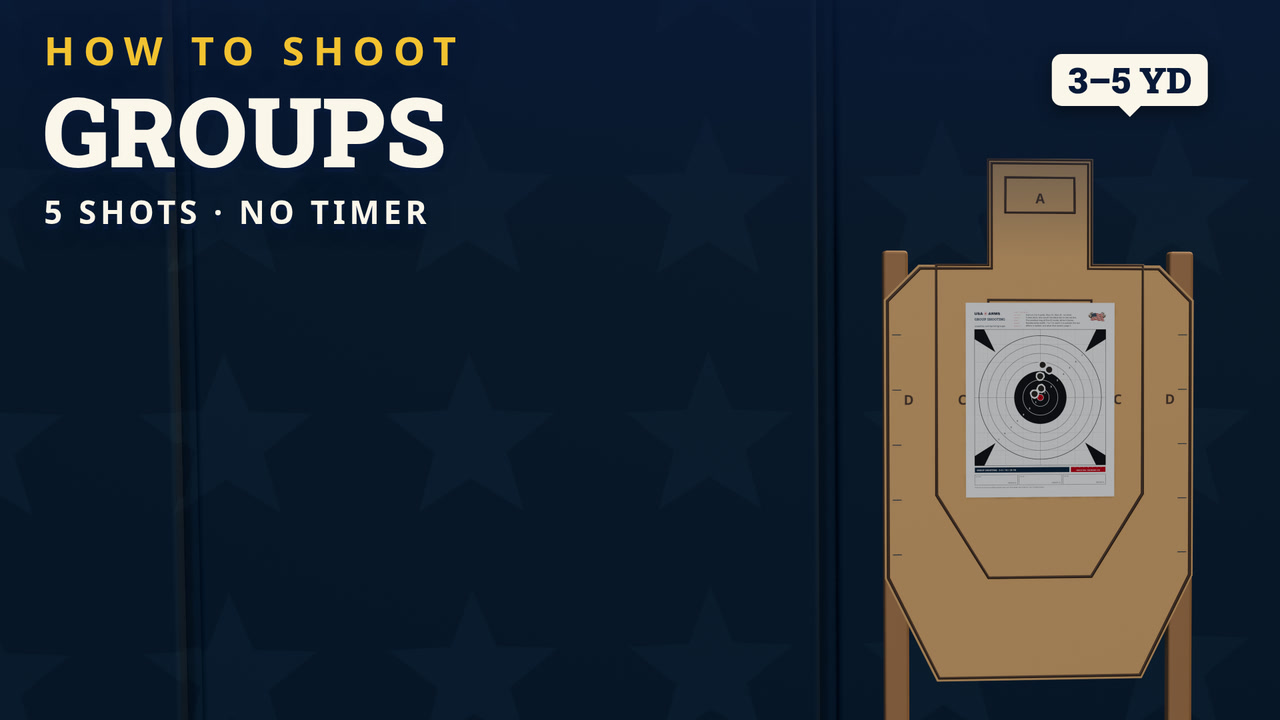
The video could not load here. Watch it on YouTube. The complete transcript is below.
Read the transcript ↓Watch on YouTube
Full video transcript 1:46
- 0:00
If you're new to shooting, groups are one of the first exercises you should practice.
- 0:04
Five slow shots at one target, with no timer.
- 0:07
Start close, at three to five yards.
- 0:10
Up close, it's easier to see what's going wrong. Half an inch off at five yards is an inch off at ten, and an inch and a half at fifteen.
- 0:18
Look at two things: how big the group is, and where it landed compared to where you aimed.
- 0:22
The rings are numbered by how wide they are, one to seven inches, so each ring is half an inch outside the last. This group fits in the two.
- 0:30
We made a printable target for this one: one bullseye, with rings to measure your group, and a guide to reading it on the second page. Print it and toss it in your range bag.
- 0:38
When you shoot, aim small, so you miss small. Lock your eyes on the tiny black dot in the center of the red dot.
- 0:44
Here's a small exercise. Print two targets. On the first, just aim at the black center. On the second, focus on that tiny dot. Aim small, miss small.
- 0:52
A wide group usually means something in your basics is moving: your grip, your sight picture, or your trigger.
- 0:58
Here's the chart for right-handed shooters. Low and left, you're probably jerking the trigger.
- 1:03
High and right is often heeling: pushing the heel of your hand forward, ahead of the recoil.
- 1:08
If your shots are on the left side of the target, or on the right side, it can be your trigger finger, or overgripping with your main hand.
- 1:14
Use the center of the pad of your trigger finger, and grip harder with your support hand than your main hand.
- 1:20
For lefties, it's all flipped.
- 1:22
When you're just starting out, it's hard to know if your optic is zeroed well or if it's something else. The goal is to notice what's happening, and how the small details affect your groups. Shoot a few groups the same way, and compare them.
- 1:33
If you need a video on zeroing, we've got one for that.
- 1:36
I like it for a first range day: no timer, just five shots to learn from.
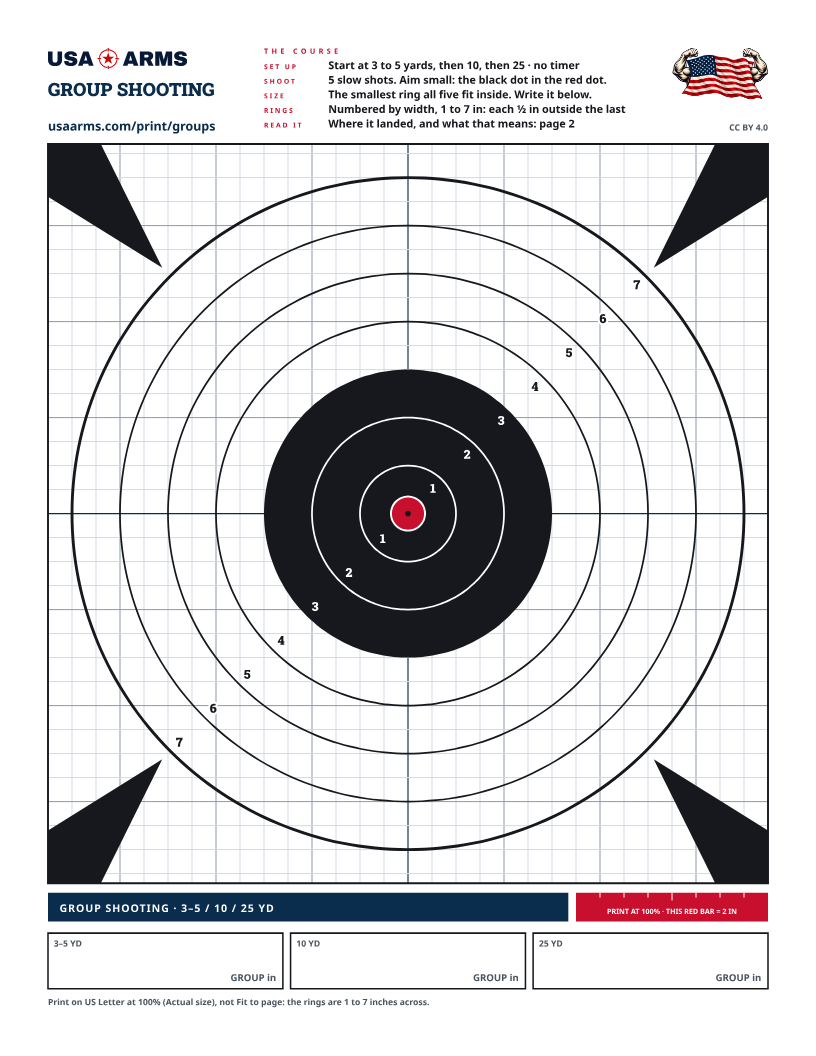
Printable target
Download the color PDF (US Letter, 2 pages, 2.1 MB)
Download the low-ink grayscale PDF (US Letter, 2 pages, 1.2 MB)
Print it at 100% (Actual size), not Fit to page, so the target measures true.
- Distances
- 3 to 5, 10, then 25 yards
- Group
- 5 shots
- Time limit
- None
- Published reference
- Ben Stoeger
Distance and shot count
Our printable target has one bullseye with rings sized to measure a group, and a second page on reading it. Its course is five slow, untimed shots at three to five yards, then ten, then twenty-five, each group marked before moving back. [1]
Group shooting has no single required course. Ben Stoeger discusses five-, six- and ten-shot groups, different targets and longer distances, including his own use of fifty yards. [2]
Consistency and equipment checks
Stoeger uses groups to examine consistency, test equipment and check sight settings. The exercise removes the time limit found in a timed drill. [2]
A group reflects both the firearm-and-ammunition combination and the shooter. The holes alone cannot isolate which caused a particular result. [2]
Group size and placement
Group size describes the spread of the hits. Placement describes the group’s position relative to the intended point. A tight group off-center and a wide group centered on the mark are different results. [2]
An offset may involve the equipment, the shooter or both. Repeated groups under the same conditions provide more information than one target. [2]
On our target, a group’s size is the smallest ring it fits inside. [1]
Comparing groups
Use the whole group when comparing sizes. The tightest two holes from a ten-shot group are not a measurement of that ten-shot group. Stoeger recommends keeping shot count consistent. [2]
Distance, ammunition, equipment and whether the gun was supported also affect the comparison. Record those conditions with the group. [2]
Sources and further reading
- USA Arms — Group shooting targetusaarms.com
- Ben Stoeger — Group Shootingbenstoeger.com
Sources reviewed September 29, 2026. Next review by March 29, 2027. Send a correction with a supporting source.