

USPSA Target Scoring
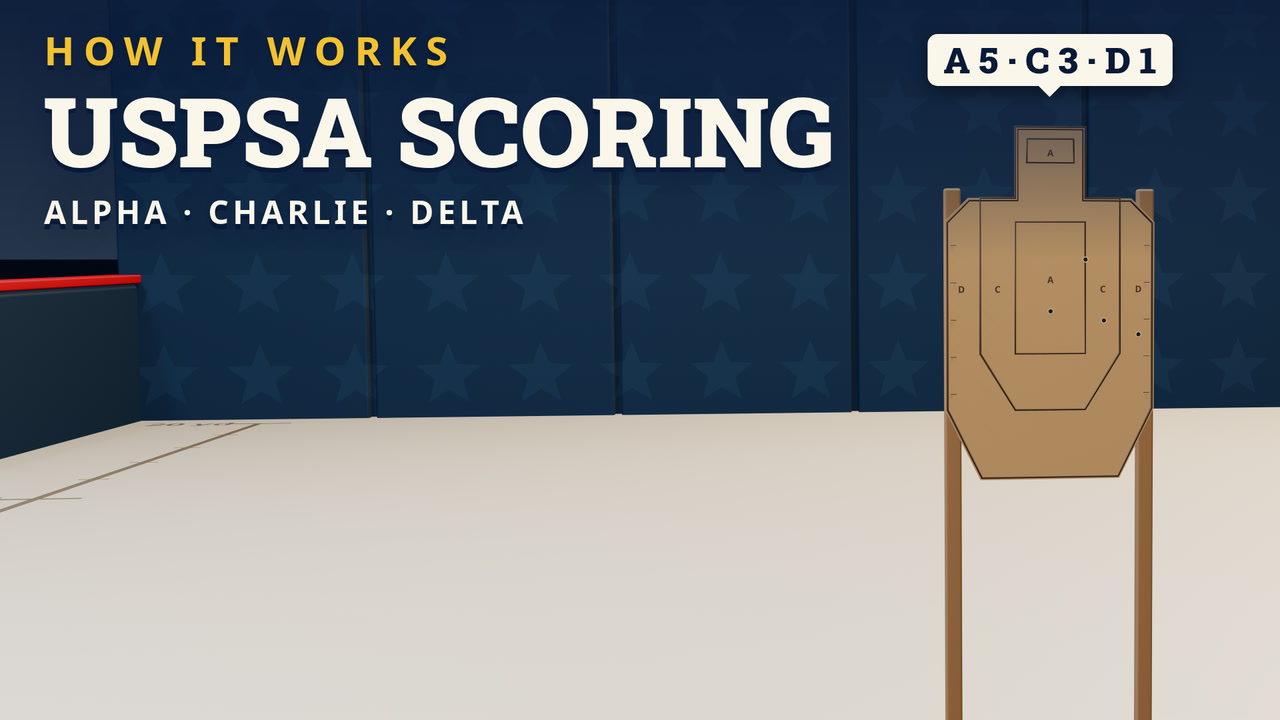
Alpha, Charlie and Delta hits have different point values in USPSA’s Major and Minor scoring. A missing required hit also carries a separate penalty.
The video could not load here. Watch it on YouTube. The complete transcript is below.
Read the transcript ↓Watch on YouTube
Full video transcript 2:48
- 0:00
USPSA scoring, and why the fastest run doesn't always win.
- 0:04
Alpha, Charlie and Delta.
- 0:07
Here's how hits are scored for nine millimeter: Alpha is five, Charlie is three, Delta is one.
- 0:13
So two Alphas and two Charlies is sixteen points.
- 0:16
If a hole touches the line between two zones, you get the higher one. A hole that just touches the edge of the scoring area still counts.
- 0:23
A miss costs ten points, and so does hitting a no-shoot.
- 0:27
Now, hit factor. Take your points, subtract your penalties, and divide by your time.
- 0:32
Eight Alphas in eight seconds is forty points, a five. Six Alphas and two Charlies is thirty-six; shoot that in seven point two, and it's a five too.
- 0:41
Now rush it. Say you drop three Charlies and two Deltas. Six seconds flat, but twenty-six points is only about a four point three.
- 0:48
The fastest run lost. You have to balance speed with points.
- 0:52
Hit factor is only part of the game. At a match, it turns into stage points, and that adds a bit more math.
- 0:57
The best hit factor on a stage gets all of its points, and everyone else gets a share. Say a stage is worth a hundred and the top hit factor is six. Shoot a three, that's half, so you get fifty.
- 1:07
Add up your stage points, and that's your match.
- 1:10
So here's the hack, if you aren't a math nerd: one second is worth about your hit factor in points.
- 1:16
Shoot a five, and every second is worth five points. Shave a second, and you can give up five points and still break even.
- 1:22
A Charlie costs you two points. At a five, it has to save you four tenths of a second.
- 1:27
A Delta costs four points, so it has to save you most of a second.
- 1:31
A miss costs ten points, which, when you consider it could have been an Alpha, is minus fifteen. For this to make sense, you'd need to shave off three whole seconds. In general, misses are always a bad idea.
- 1:41
Here's that on four targets, two shots each. All Alphas in eight seconds is a five. Two Charlies have to finish in seven point two to match, two Deltas in six point four, and a miss in five flat.
- 1:53
Here, it illustrates the speed difference on an eight-shot course, but the tradeoff depends on the stage.
- 1:58
On a fast stage, where most people's hit factor is around ten, a Charlie only has to save you a fifth of a second, so focus on speed.
- 2:05
Now on a slow stage, where it's around four, it has to save you half a second, so focus on accuracy and get your Alphas.
- 2:11
But how do you know which stages those are? Here are the ten classifiers people shoot the most, ranked by the typical hit factor.
- 2:17
Where it's just stand and shoot, hit factors run high, so focus on speed.
- 2:22
Where there's something slow built in, a seated start, a turn, moving, or far targets, they run low, so focus on accuracy and get your Alphas.
- 2:30
If you want to really nerd out, HitFactor.info has the scores for every classifier.
- 2:35
What I like about USPSA scoring is that you can't just be fast or just be accurate. You have to find the balance on every stage.
- Target
- USPSA cardboard
- Scoring zones
- Alpha, Charlie, Delta
- Point columns
- Major and Minor
- Authority
- USPSA rules
Alpha, Charlie and Delta points
The standard USPSA cardboard target has Alpha, Charlie and Delta areas, including a small upper Alpha zone. The outer border is non-scoring; there is no printed “miss” zone. [1] [2]
Alpha is worth five points in both columns. Charlie and Delta values differ. Match division and power-factor rules determine which column applies. [2]
| Zone | Major | Minor |
|---|---|---|
| Alpha | 5 | 5 |
| Charlie | 4 | 3 |
| Delta | 2 | 1 |
Hits touching a scoring line
A qualifying hit that touches an internal scoring line receives the higher value. The outer non-scoring border is not another scoring zone. [2] [1]
The USPSA rulebook defines how close hits are measured and adjudicated in a match. [2]
Miss penalties and hit factor
A missing required hit normally receives a ten-point penalty, in addition to earning no target points for that hit. The scoring method and rule exceptions still apply. [2]
Hit factor is points after penalties divided by time. Both the retained points and elapsed time affect the result. [2]
Scoring a drill on the same target
Using a USPSA target does not automatically mean using USPSA match scoring. Published drills may require all Alpha hits, use hit factor or add time penalties. [3] [4]
IDPA uses a different target and currently adds one second per point down. Wilson’s original 5×5 sheet uses older half-second scoring, compared on the separate 5×5 pages. [5] [6]
Sources and further reading
- USPSA — Appendix B1 cardboard targetrules.uspsa.org
- USPSA — official competition rulesrules.uspsa.org
- KR Training — Drills, Qualifications, Standards and Testsblog.krtraining.com
- Karl Rehn — Relative Performance Measurementblog.krtraining.com
- IDPA — 2026 Rulebookidpa.com
- Wilson Combat — original 5×5 test sheets3.amazonaws.com
Sources reviewed September 29, 2026. Next review by March 29, 2027. Send a correction with a supporting source.